EPG Hub
OTT Navigator EPG Guide: Setup, Mapping & Troubleshooting
Learn how OTT Navigator gets programme-guide data, how to reload and configure an EPG source, how channel matching works, and how to isolate blank, incomplete, or incorrectly timed guide data.
What is EPG in OTT Navigator?
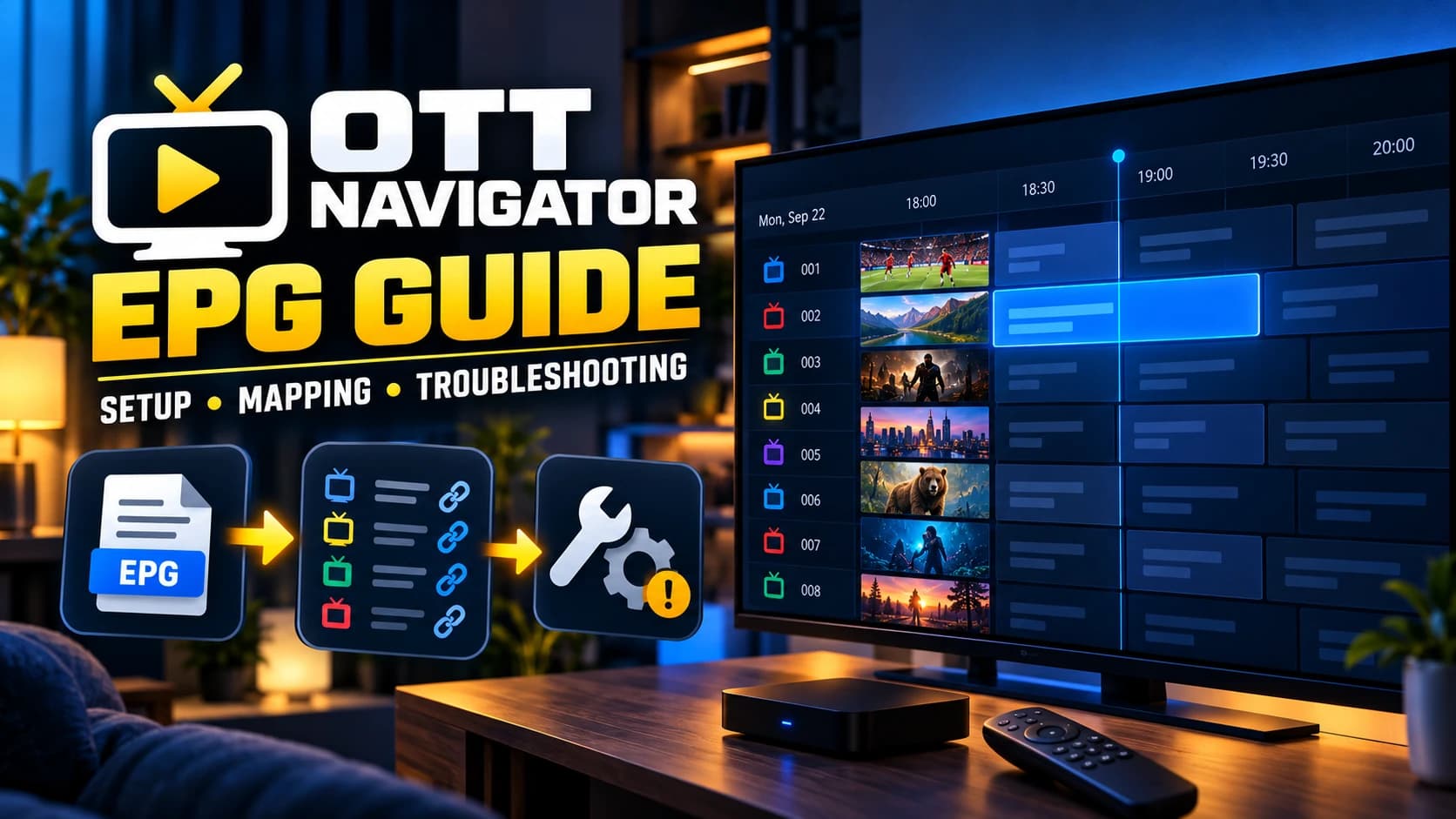
EPG stands for Electronic Program Guide. It adds programme information to live-TV channels, such as what is currently playing and what is scheduled next. It is separate from the video stream itself: a channel can play normally while its guide data is missing or incorrectly mapped.
The current OTT Navigator listing identifies EPG as a supported feature, while the official FAQ documents several ways to load and match guide data.
First check: does the playlist work?
Before changing EPG settings, make sure the underlying provider or playlist loads. If channels themselves are missing, fix the playlist/provider configuration first. If channels load and play but the programme grid is empty, the problem is much more likely to be the EPG source or channel mapping.
Channels missing
Investigate the playlist, provider credentials, URL, or provider response.
Channels work, EPG missing
Investigate EPG source availability and channel-to-guide matching.
How to reload EPG data
The official FAQ gives a direct diagnostic path: open Settings → EPG → Reloadand watch the reload status. It specifically recommends looking at the number of sources processed and the result reported for each source.
- Open OTT Navigator settings.
- Go to the EPG section.
- Start Reload.
- Watch the processing status rather than immediately assuming the guide failed.
- If the source is processed but channels remain unmapped, move to the channel-matching checks below.
Provider EPG vs user-provided EPG
There are two important configuration paths in the official FAQ. If your provider has an EPG source but does not include it in the playlist, OTT Navigator recommends configuring that source under the provider's parameters: Settings → Provider → your provider → Parameters → EPG.
A user-provided EPG configured under Settings → EPG → User-providedbehaves differently for matching: the FAQ states that this path uses matching by channel name only. Provider-level EPG configuration can search by both channel names and tvg-id.

How channel mapping works
Loading an EPG source is only half of the job. OTT Navigator also needs to associate a playlist channel with the corresponding programme-guide entry. The official FAQ describes provider-level matching by channel name and tvg-id.
| Field / signal | Role | Why it matters |
|---|---|---|
tvg-id | EPG channel identifier | Can provide a more explicit association with guide data. |
| Channel name | Human-readable channel label | Used for matching and can expose naming mismatches. |
tvg-name | Original guide channel name | Useful when the playlist name differs from the name in the guide. |
The FAQ's M3U documentation also identifies tvg-id as the channel ID used with the EPG guide configured for the playlist/provider, andtvg-name as the original channel name when it differs from the playlist name.
Where XMLTV and url-tvg fit
In the M3U technical documentation, OTT Navigator describes the url-tvgplaylist attribute as the path to an EPG guide in XMLTV format, either XML or compressed XML. That means the playlist can carry a reference to guide data rather than embedding the entire programme schedule into every channel entry.
Conceptual flow
Playlist → channel metadata → EPG source → channel matching → programme schedule
A failure at any stage can produce a different symptom, so troubleshooting should identify the failing layer instead of repeatedly reloading the same source.
EPG source vs. EPG mapping
Two different failures can look identical on screen: the EPG data may not have loaded at all, or the data may have loaded but failed to match the channels. Treat these as separate tests.
| Test result | Interpretation | Next step |
|---|---|---|
| EPG reload fails | Source retrieval or configuration problem. | Check the EPG URL/source and network access. |
| Reload succeeds, no guide entries | Possible channel matching/mapping issue. | Inspect channel identifiers and names. |
| Some channels have guide data | Partial mapping or incomplete source data. | Compare working and missing channel metadata. |
| Guide entries exist but times are shifted | Time-zone or source-time interpretation issue. | Check device time zone and source configuration. |
EPG troubleshooting matrix
| Symptom | First check | Likely layer | Next action |
|---|---|---|---|
| EPG completely empty | Run EPG Reload and inspect source results. | Source / configuration | Verify provider EPG or configure the intended source. |
| Only some channels have EPG | Compare channel names and identifiers. | Mapping | Check tvg-id, names, and provider mapping. |
| Source reloads but no programmes appear | Check whether the source result is successful. | Source or matching | Separate “data loaded” from “channel matched.” |
| Programme times are shifted | Check device timezone and time settings. | Time configuration | Correct device time first, then use documented time-shift options if needed. |
| EPG worked before and stopped | Reload and inspect source processing. | Source availability / provider | Check whether the provider's guide endpoint or playlist metadata changed. |
Incorrect EPG times
The official FAQ says incorrect device timezone settings are a common reason for incorrect EPG times. It recommends correcting the device time and timezone first. If that does not resolve the issue, documented options include visual or system time shifts, a per-channel EPG time shift, or a provider-level time shift. After changing a time-shift setting, the FAQ says to manually reload EPG data.
Do not change time-shift settings simply because the guide is empty. A timezone problem changes programme timing; it does not by itself prove that the EPG source failed to load or that a channel was mapped incorrectly.
A practical EPG decision tree
- Do channels load? If not, fix the playlist/provider first.
- Does EPG Reload process a source? If not, investigate the EPG source/configuration.
- Does the source process successfully but channels remain blank? Investigate channel mapping.
- Are only certain channels affected? Compare their names and EPG identifiers.
- Is the guide populated but shifted in time? Check device timezone before applying a time shift.
Related OTT Navigator guides
Official sources
For current app capabilities, distribution details, and documented settings, verify details against the product's published resources.